Auditory hallucinations and visions
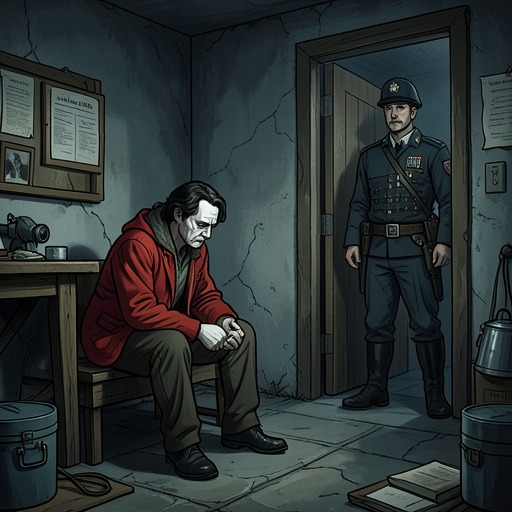
Guantanamo DiaryAuditory hallucinations and visions mark a point at which Mohamedou Ould Slahi’s isolation becomes both an inward crisis and an opportunity for his guards to manipulate him. He describes hearing family, Quran recitation, and music while deprived of sleep and living on water; the voices persist despite his efforts to remind himself that he is not near his family. His account also distinguishes those involuntary experiences from the guards’ deliberate use of voices through the plumbing, which he recognizes as an attempt to provoke him.
Conditions and Onset
The voices arise during a period of severe deprivation and fear. Slahi describes having no sleep, consuming only water, and waiting constantly for another torture session. Every movement behind his cell door made him stand, his heart pounding; he had no appetite and hoped for death as an end to his suffering. This context establishes the circumstances in which he began to hear things, without turning his account into a medical diagnosis or claiming a single cause.
The sounds he reports are particular and intimate rather than an undifferentiated noise. He hears his family speaking casually, as if in an ordinary conversation from which he cannot take part. He also hears Quran recitation in what he describes as a heavenly voice, and music from his country. The experiences bring familiar people, religious sound, and home into a setting defined by separation, but they do not restore contact with any of them: the family conversation remains one he can hear but cannot join.
Voices Used Against Him
The guards later speak through the plumbing in funny voices, encouraging him to hurt them and plan an escape. The episode makes the auditory experience a point of contact between involuntary distress and deliberate provocation. The guards exploit the fact that Slahi is hearing voices, turning the plumbing into a means of addressing him and testing his response.
Their remarks frame the sounds as possibly coming from a genie. Slahi plays along, but says he is not listening to the voice. His response matters because it separates hearing a sound from accepting its instruction: even as the voices continue, he understands that the guards are speaking through the plumbing and does not follow the suggestions. He also recognizes that he is close to losing his mind, a recognition that coexists with his ability to identify this particular deception.
Recognition, Isolation, and Prayer
Slahi tries to convince himself that he is not in Mauritania and cannot be near his family, so that he cannot actually hear them. The effort does not stop the voices, which he says continue day and night. His account thus presents recognition and control as different things: he can question the reality of the family voices without being able to silence them. He begins talking to himself, while psychological assistance and meaningful medical assistance remain unavailable to him.
At a moment when he cannot find a way forward and does not know whether it is day or night, he guesses the direction of prayer, kneels, and prays. He suppresses his tears and voice so that the guards will not hear him. He reflects that prayer can be serious or lazy and that his experience has taught him God responds to serious prayer. The passage does not claim that prayer ends the hallucinations; instead, it shows him turning to faith while unable to resolve the voices or obtain help.
Narrative Significance
The sequence moves from private auditory experiences to their exploitation by the guards, then to Slahi’s effort to orient himself through prayer. Its details keep the reader close to what he hears while preserving the distinction between family voices he knows cannot be present and the guards’ actual voices coming through the plumbing. The result is not a simple confusion of reality: Slahi describes distress and uncertainty, but also his recognition of the guards’ ploy and his refusal to obey it.
The voices carry contradictory meanings. Family, recitation, and music suggest forms of connection that detention has removed from ordinary reach; the guards’ voices turn that same channel into a threat and a test. Slahi’s account leaves the hallucinations unresolved, emphasizing both their persistence and the limits of the assistance available to him. Prayer becomes an act of orientation within that unresolved state, not a narrated cure.